
Home / Blogs / How Excel Reporting Can Reduce Visibility in your Month-End
How Excel Reporting Can Reduce Visibility in your Month-End

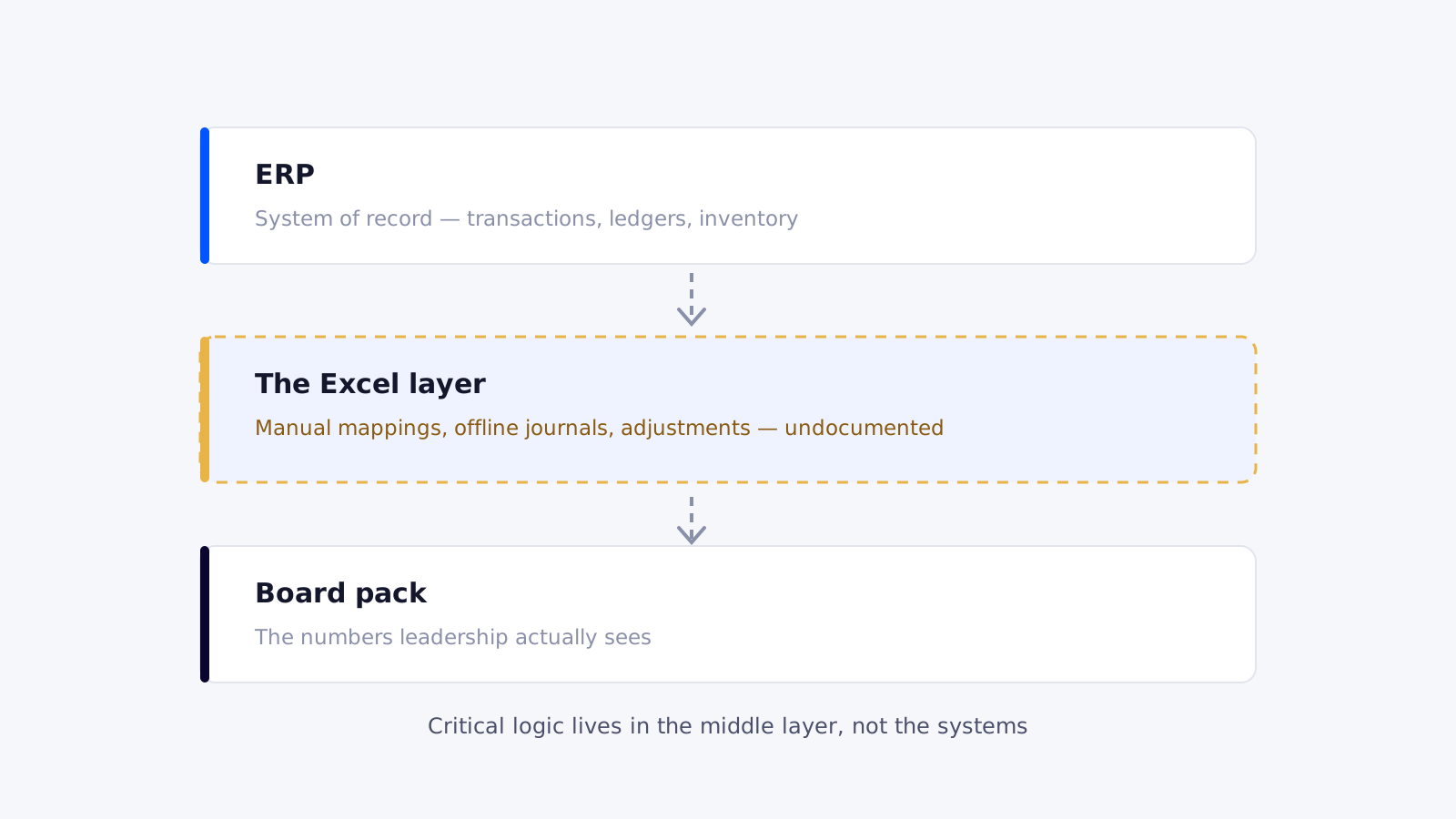
Many of the finance teams we’ve worked with have been running on a shadow system: an Excel spreadsheet with hard-coded cells, manually entered data and age-old formulas that are too heavy and confusing. That spreadsheet sits quietly between the ERP system and the board pack, and it leads to long hours spent manually validating numbers.
It has probably never been reviewed by IT. But if it disappeared tomorrow morning, reporting would stop. That hidden reporting infrastructure is what many finance leaders now call the Excel layer.
The Excel layer is the unofficial reporting system finance teams build when the ERP cannot fully support the reporting, consolidation, analysis and flexibility the business actually needs. In manufacturing finance it becomes surprisingly common, because while ERP systems process transactions, finance teams still need to explain:
- FX fluctuations
- Intercompany movements
- Margin shifts
- Inventory valuation changes
- Cost allocations
- Multi-entity consolidation
- Forecast variances
- Commodity cost impacts
The uncomfortable truth for many Finance Directors: the board pack may technically come from the ERP, but the logic behind the numbers often lives somewhere else entirely.
How does the Excel layer start?
The Excel layer rarely appears because a finance team wants it. A controller creates a temporary mapping table. A financial accountant builds a consolidation workbook. A management accountant creates a margin bridge the ERP cannot calculate cleanly. A new acquisition introduces another chart of accounts. Someone builds a workaround. Every step makes sense at the time.
But soon one spreadsheet becomes five. Five become twenty. Month-end reporting depends on offline workbooks, key calculations sit inside nested formulas, different entities use different logic and manual reconciliations become normal. Nobody fully understands every dependency anymore — and finance is no longer reporting from the ERP.
Why do manufacturing finance teams rely so heavily on Excel?
Manufacturing finance complexity is rarely linear. Unlike simpler service organisations, manufacturers deal with layered operational and financial complexity that standard ERP reporting often struggles to explain clearly.
1. Multi-entity reporting
A UK manufacturer acquires two overseas entities. One runs SAP, another runs Dynamics 365 Business Central, the parent uses NetSuite. Finance must now produce consolidated reporting, FX-adjusted margin analysis, intercompany elimination and standardised board reporting. The ERPs hold the transactions, but the reporting logic between them gets handled manually — so the Excel layer grows.
2. Inventory and costing complexity
Raw material prices increase sharply during the quarter. Inventory produced in January is sold in April. Commodity costs changed significantly in between. The CFO asks: “Is the margin reduction operational, or commodity-driven?” That answer rarely exists neatly inside a standard ERP report, so finance builds offline analysis — and the Excel layer expands.
3. Intercompany reporting
Many manufacturing groups still rely on manual matching, spreadsheet-based eliminations, offline journals, email approvals and shared-drive reporting files. Over time these temporary fixes stop feeling temporary. And in the best case — where you find every error — your team will still have wasted hours combing through a sheet that takes 15 minutes to load (when it doesn’t crash).
Why is the Excel layer so risky?
This doesn’t mean using Excel is wrong. The real problem is when critical financial logic exists only inside fragile manual processes.
Key-person risk
Many finance teams quietly depend on one person — the one who remembers which adjustment gets reversed every quarter. If they leave, reporting slows down immediately. That is institutional memory disguised as process.
Version chaos
Final_Report_v2.xlsx, FINAL_v4_UPDATED.xlsx, Final_FINAL2_JR.xlsx… At some point reporting becomes less about analysis and more about confirming which version is correct. When board decisions rely on those files, confidence erodes.
Lack of traceability
With the Excel layer, drill-down often stops. The dashboard shows a number, but tracing it back to source transactions becomes painfully manual. A CFO presents margin performance, someone asks “Why did this move?” — the answer should take seconds, but instead finance spends hours reopening files and validating adjustments. That hesitation damages confidence faster than most leaders realise.
How can finance leaders tell if the Excel layer has become a problem?
- Your month-end close still feels manual — days spent validating spreadsheets, rebuilding logic, reconciling exports and updating mapping tables.
- Reporting depends on individual knowledge — only one or two people fully understand the process.
- The ERP cannot answer board-level questions quickly — every leadership question requires offline analysis.
- Finance spends more time preparing data than analysing it — one of the clearest signals.
How do leading manufacturing finance teams reduce Excel dependency?
The strongest finance functions don’t eliminate Excel — they eliminate dependency on it. Excel still has value for scenario modelling, ad-hoc analysis, planning and forecast testing; it just shouldn’t be the hidden infrastructure behind board reporting. Leading manufacturers focus on:
- Centralised reporting logic — calculations move into governed reporting environments.
- Automated consolidation — intercompany eliminations, mappings and entity reporting become standardised.
- Drill-down traceability — move from board pack to management report to transaction detail without rebuilding the audit trail.
- Transparent data governance — everyone works from the same version of the truth.
What happens when finance removes the Excel layer?
The benefits go beyond faster reporting — the real improvement is confidence. With a transparent reporting structure, our clients stopped second-guessing numbers, teams spent less time validating data, board conversations became sharper and month-end pressure reduced. Finance stops acting like a reporting factory and starts acting like a strategic decision-making function. That shift is where real transformation happens.
FAQ: the Excel layer in manufacturing finance
Why do finance teams still rely on Excel after ERP implementation?
Because ERP systems often solve transaction processing more effectively than reporting complexity.
Is Excel bad for finance reporting?
Not necessarily. It becomes risky when critical reporting logic depends entirely on manual files, undocumented formulas and individual knowledge.
How can finance teams reduce manual reporting?
By introducing automated consolidation, governed reporting environments, integrated dashboards and transparent drill-down reporting.
Quick summary
- The Excel layer is the unofficial reporting system sitting between ERP data and board-level reporting.
- Manufacturing complexity often drives spreadsheet dependency.
- The biggest risks are key-person dependency, version chaos and lack of traceability.
- Leading teams reduce dependency by centralising logic and automating consolidation.
- The goal is not just faster reporting — it is confidence in the numbers.
Ready to trust your numbers again?
Book a free 30-minute call and we’ll talk through your current reporting and what’s possible.