
The first answer for a lot of teams we have worked with is usually, “That’s just how long our Month-end processes take.”
And if you think about it… you’ll see alot of time unaccounted for.
Which your team spends in validation, fixing errors, reconciling numbers, or some other avoidable and manual task.
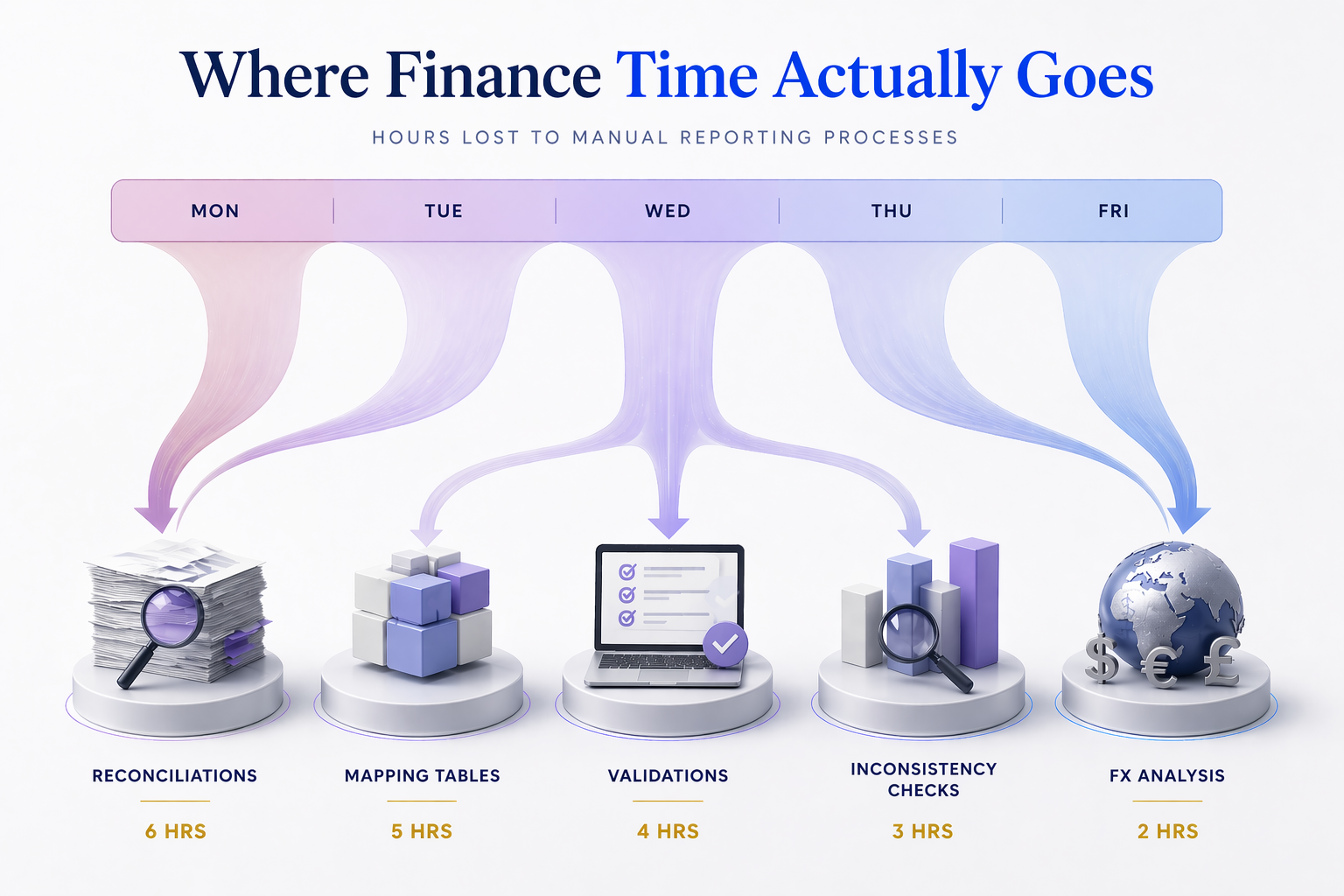
And before you know it, your team has lost over 15 hours a week during month-end.
Welcome to the hidden cost of manual finance processes.
What Are Manual Finance Processes?
Manual finance processes are repetitive, human-driven tasks involved in reporting, reconciliation, and data preparation.
They include:
- Data entry
- Spreadsheet reconciliation
- Manual adjustments
- Report building
And they’re quietly draining your team’s time.
Where Does Time Get Lost in Manual Finance Processes?
1. How do reconciliations consume time?
Reconciling data across systems takes hours.
Especially when numbers don’t match, which is common when systems don’t talk to each other as they should.
2. How do mapping and adjustments slow teams down?
Manual mappings:
- Need constant updates
- Create inconsistencies
- Require validation
All of which add to manual finance processes.
3. How do inconsistencies create rework?
Different reports show different numbers. So, teams:
- Recheck data
- Rebuild reports
- Revalidate outputs
Time spent here adds up fast.
What Does This Look Like in Real Life?
Example: The “11-hour week”
A finance team we worked with had their finance analyst spending:
- 4 hours reconciling data
- 3 hours validating reports
- 2 hours fixing errors
- 2 hours explaining inconsistencies
That’s 11 hours.
Gone.
Not on analysis or insight, but on just maintaining the process.
If you want to know how your finance team can achieve a one-day Month-End, check out our simple guide!
Why Is This a Bigger Problem Than It Looks?
Because it’s not just time. It’s:
- Lost productivity
- Reduced job satisfaction
- Increased burnout
And ultimately, weaker decision-making.
How Can You Reduce Manual Finance Processes?
1. How do you eliminate repetitive tasks?
Identify:
- Data entry
- Reconciliation
- Report generation
Then automate them.
2. How do you connect systems?
Fragmented systems create manual work. Integration removes it.
3. How do you shift focus to analysis?
When manual work is reduced:
- Teams analyse data
- Leaders get insights
- Decisions improve
That’s the real goal.
How Do You Reduce Manual Finance Processes in Practice?
At this point, you can probably see where the time is going.
The harder question is:
“How do we actually get it back?”
We’ve discussed that reducing manual finance processes isn’t about telling your team to work faster, but about redesigning how the work gets done.
Step 1: How do you identify hidden manual work?
Most manual work isn’t obvious. It sits inside:
- Spreadsheet checks
- Data validation steps
- “Quick fixes” that happen every month
So the first step is visibility.
Ask your team:
- What tasks do you repeat every month?
- What takes longer than it should?
- What breaks most often?
That’s where your manual finance processes are hiding.
Step 2: How do you prioritise what to fix first?
Not all manual work is equal.
Focus on tasks that are:
- Repetitive
- Time-consuming
- Prone to error
Typically, this includes reconciliations, data consolidation, and report preparation.
Reducing these first has the biggest impact on manual finance processes.
Step 3: How do you replace manual steps with automation?
With automation, we don’t mean removing people. Just allowing your skilled team to do what they’re good at by removing the repetitive tasks off their plate.
For example:
- Data extraction can be automated
- Reports can update automatically
- Reconciliations can be system-driven
This is where finance teams start to win back hours from manual finance processes.
Step 4: How do you connect fragmented systems?
A huge amount of manual work exists because systems don’t talk to each other.
So teams act as the connector.
When you integrate:
- ERP
- Operational systems
- Reporting tools
You remove the need for manual stitching (one of the biggest sources of manual finance processes for the finance teams we’ve worked with).
Step 5: How do you shift the team’s role from processing to analysing?
This is the real transformation.
When manual work is reduced:
- Finance analysts stop being “data handlers”
- Controllers focus on insights, not checks
- Finance leaders get faster, clearer answers
That’s when finance becomes a strategic function, not just a reporting one.

So What’s the Next Step?
If you’re looking at your team’s workload and thinking:
“We’re spending too much time just keeping the numbers together”
You’re not alone.
But the biggest mistake is trying to fix everything at once.
Instead, start with:
Understanding exactly where manual effort is sitting in your process and what to automate first.
That’s exactly what we cover in our guide:
“How Finance Directors Can Get Control Back Through Visibility”
Inside, you’ll find:
- The most common sources of manual effort
- How to identify inefficiencies in your reporting process
- A practical approach to reducing manual finance processes step by step
Because the goal isn’t just saving time.
It’s giving your team time back to do work that actually matters.
Key Takeaway
- Manual finance processes are the biggest hidden time drain
- Most lost time comes from reconciliation and validation
- Automation frees teams to focus on insight, not data
Summary
Manual finance processes include repetitive tasks like reconciliation, data entry, and report building. These processes reduce efficiency, increase errors, and consume significant time. Automation and system integration help eliminate manual work and improve productivity.
FAQs
What are manual finance processes?
Tasks like reconciliation, data entry, and report preparation done manually.
Why are manual process in finance a problem?
They consume time, increase errors, and reduce efficiency.
How can manual processes be reduced?
Through automation, system integration, and process standardisation.